
When Megan Ahmann walked into Western Dubuque High School, she wasn’t just a guest speaker. She was a former student stepping back into the classroom where her own future once felt uncertain.
Now a first-year medical student at the University of Iowa Carver College of Medicine, Ahmann returned to her hometown school through the Hawkeye Hometown Visit program — an outreach effort that connects medical students with K-12 classrooms across Iowa.
If [students at my high school] had questions and they just didn’t know where to reach out to or where to start, maybe I could help - Megan Ahmann
Growing up near Dubuque, Ahmann was always interested in science. But she didn’t personally know anyone working in health care. “At the time of high school, I didn’t really have exposure. I didn’t know anybody,” she says. “Nobody in my family had gone to college, let alone attended medical school.”
She remembers wishing she had someone closer to her age who could explain what the path actually looked like — someone who had come from a similar background and figured it out.
That memory shaped her decision to go back.
“If [students at my high school] had questions and they just didn’t know where to reach out to or where to start, maybe I could help,” Ahmann says.
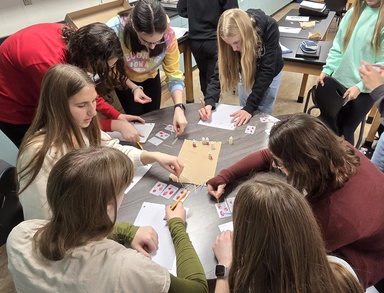
During her visit in December 2025, she led students through a synthetic blood-typing activity and talked through her journey to medical school. But what stayed with her most was the reminder of where she started. “I would say that it was very humbling,” she says. “Sometimes you hyperfocus on the what-ifs going forward… and you don’t always do such a good job of reflecting on the things you have done.”
Watching students encounter new concepts for the first time reminded her of her own curiosity — and how far she has come since sitting in those same desks.
A full-circle moment
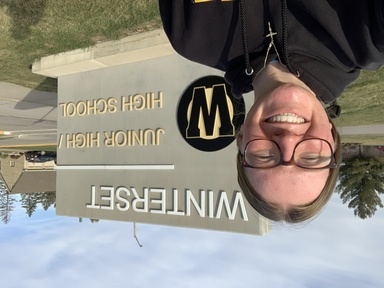
For Kacie Cowman, a second-year medical student at the Carver College of Medicine, returning home to Winterset felt just as personal.
“It was very nostalgic to be back there and just think, I was in their seat not that long ago,” Cowman says.
She gave her presentation in the same classroom where she first fell in love with science — a moment that made the visit feel “full circle.”
“To come back and be like, ‘Look, I’m where I’ve wanted to be for so long, and you can do it, too,’” she says. “It was cool to look back and see how far I’ve already made it.”
Cowman says she would have loved to hear from a medical student — especially a woman in medicine — when she was in high school. The first time she spoke with someone currently in medical school wasn’t until college.
That’s part of why returning mattered.
To come back and be like, ‘Look, I’m where I’ve wanted to be for so long, and you can do it, too.' It was cool to look back and see how far I’ve already made it - Kacie Cowman
When students asked Cowman how she prepared for medical school, she encouraged them to pursue experiences that may feel intimidating — like becoming an EMT — even if they feel unsure.
“Just do something that you’re interested in, even if it scares you a little bit,” she says.
Growing across Iowa
This year, Hawkeye Hometown Visits have already taken place at high schools in Epworth, Winterset, Bettendorf, and Ankeny, reaching more than 360 students, with additional schools still scheduled.
The program has grown steadily over time. In 2018, four visits engaged nearly 400 students. Two years later, 18 visits reached more than 1,000 students statewide — including more than 500 in rural communities. In recent years, visits have continued across Iowa, connecting with hundreds of middle and high school students annually.
But beyond the numbers, the impact is personal.
For Ahmann and Cowman, returning home wasn’t just about explaining prerequisites or leading a classroom activity. It was about standing in front of students who are exactly where they once were — curious, unsure, and trying to picture what their future might look like.
In those moments, medicine feels less distant.
It looks like someone who once sat in the same seat, asked the same questions, and found a way forward.
And for some of those students, that may be all it takes.